 Pensar
All postcards
Postcard No. 3 · Listening
Eavesdropping, but educational: Spanish listening practice that works
Why Spanish sounds so fast, why the words run together, how many words you need to follow it, and the listening practice that actually trains your ear.
 By Paco, with Shirish Kadam
· 5 min read

In this postcard
Good Spanish listening practice is short, real conversation at your level, heard more than once, with the speed under your control, and then you say back what you understood. Spanish isn’t hard to hear because your ears are bad. It packs more syllables into a second than English and runs its words together. Both are learnable.
Hola, soy Paco. I’ve spent my whole life listening to people talk, and I can tell you the secret: nobody waits for you. So let’s train the ear to keep up.
Why do Spanish speakers talk so fast?
Because they say more syllables per second. In a study of seven languages, Spanish speakers averaged 7.82 syllables a second, against 6.19 for English speakers: about a quarter more (Pellegrino, Coupé and Marsico, 2011). The authors put it neatly: “Spanish is characterized by a fast rate of low-density syllables.”
Here’s the comforting part. Each Spanish syllable carries less information, so Spanish delivers ideas at nearly the same pace as English. Same message, more, smaller pieces. Your brain isn’t drowning in content; it’s sorting more beats.
Why do the words all run together?
Because Spanish links vowels across word boundaries. ¿Qué es eso? (what’s that?) comes out as one breath, closer to “kesésso”. In one study, native speakers in Mexico linked their vowels across words 93% of the time (Willis, Holt and Carver, 2025).
That’s why you can read a sentence easily and still miss it out loud. On the page the spaces are there; in the air they aren’t.
How many words do I need to follow spoken Spanish?
Fewer than for reading. Researchers Laura van Zeeland and Norbert Schmitt estimate that at 95% coverage, listeners need “between 2,000 and 3,000 word families” (van Zeeland and Schmitt, 2013). A word family is a word and its relatives, like hablar (to speak), hablo (I speak) and hablado (spoken).
They call that figure a best case, for short, informal stories. Still, it’s a useful target: the most common couple of thousand words, met again and again, take you a long way.
Does slowing Spanish down help?
Yes, if you’re the one holding the dial. Yanhong Zhao found that when students could control the speed themselves, their comprehension improved (Zhao, 1997).
Use slow as a ladder, not a home. Slow it down to catch the shape of a line, then hear it again at full speed. Your goal is the bar at 8 p.m., and the bar doesn’t come with a 0.5× button.
What makes listening practice actually work?
Listening is the skill teachers know least about. Larry Vandergrift, who studied it for decades, called it “the least understood and least researched skill” (Vandergrift, 2007). What the research and good teachers agree on fits on a card:
- Short. Thirty seconds you can hear five times beats ten minutes you hear once.
- At your level, but real. Real rhythm and real linking, with words you mostly know.
- Listen before you read. The transcript is the answer key, not the exercise.
- Control the speed, then finish at full speed.
- Say back what you understood. In your own words, not by picking A, B or C. Producing an answer is what makes it stick, as my first postcard explains.
How does Pensar’s Listen work?
Every day there’s a scene in your city: a bar, a market stall, a bus stop. In Listen, two locals talk about it, as a chat of voice notes, the way people actually talk on their phones. They’re characters, voiced by AI in the city’s accent, at a pace set for your level.
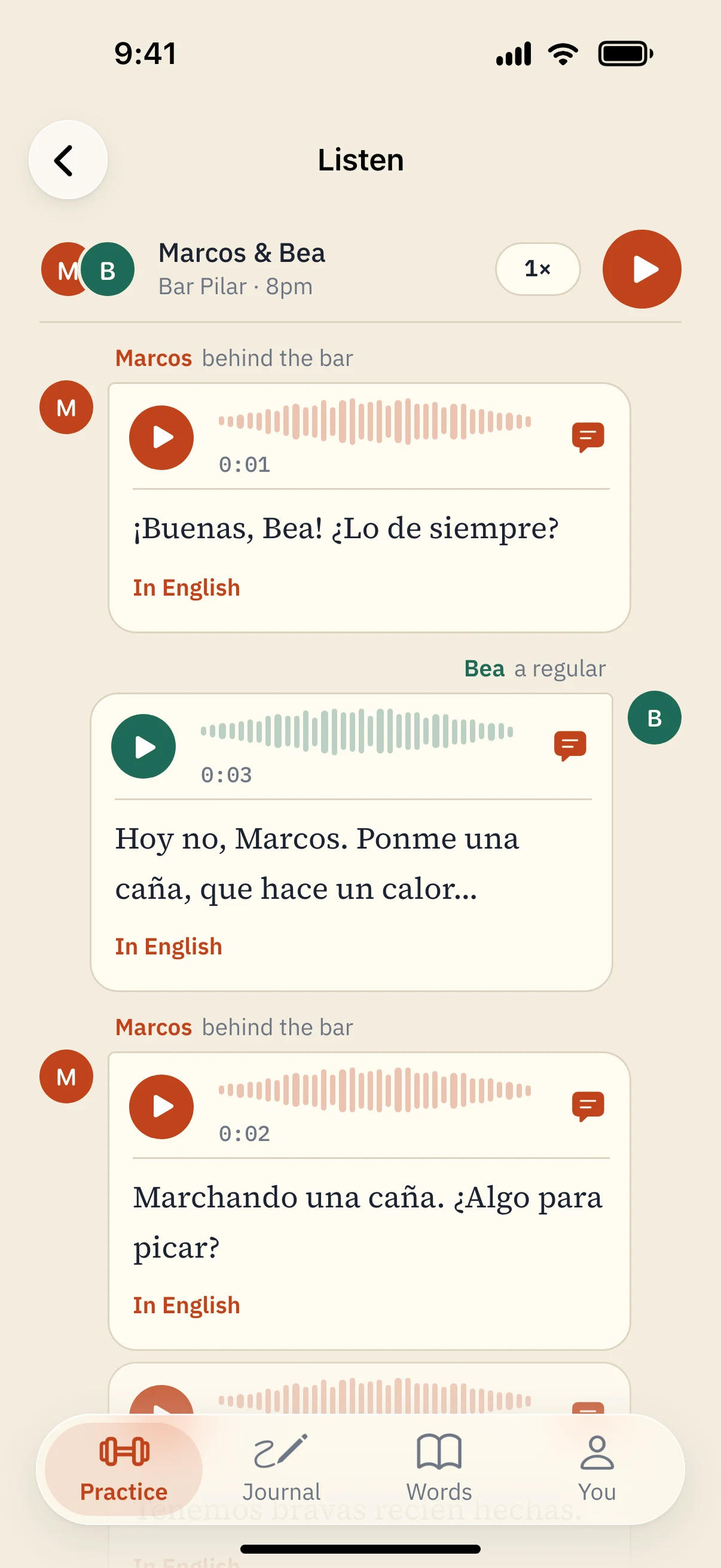
Here’s what you can do with a round:
- Replay one note or the whole chat, and scrub back a few words.
- Slow it down to 0.75× or 0.5×.
- Read along, but only after a first listen. The words stay hidden until you’ve heard the note once, so you listen before you read.
- Show the English under any line, one tap away, if you’re stuck.
Then I ask you about it. Some questions you pick, and some you answer in Spanish in your own words, typed or out loud. Out loud counts double. At the end I tell you what you just did: “That’s the bar at full speed.”
You get up to five new rounds a day, and you never get the same clip twice.
What can I do today, with or without an app?
- Pick 30 to 60 seconds of real Spanish: a voice note from a friend, a scene from a show, a podcast clip.
- Listen twice without reading. Write the three words you’re sure of.
- Listen slower once, then read the transcript, and mark what you missed.
- Listen at full speed again. It will sound slower than the first time. That’s your ear changing.
- Say what happened, out loud, in two sentences of Spanish. Who, where, what they wanted.
Do the same clip tomorrow before you start a new one.
Questions people ask
Why do Spanish speakers talk so fast?
They say more syllables per second than English speakers, about 7.8 against 6.2 in one seven-language study. But each Spanish syllable carries less information, so ideas arrive at nearly the same pace. It also links vowels between words, which makes a sentence sound like one long word until your ear learns where the breaks are.
How many words do I need to understand spoken Spanish?
A study by van Zeeland and Schmitt puts it at 2,000 to 3,000 word families for following informal speech at 95% coverage, and calls that a best case. Start with the most common words and hear them many times in real conversations; that grows your listening faster than long word lists.
Does listening to slowed-down Spanish help?
It helps when you control it. Research by Zhao found comprehension improved when learners could set the speed themselves. Slow a line down to catch its shape, then listen again at normal speed, because real conversations won’t slow down for you.
What is the best Spanish listening practice for beginners?
Short clips at your level, heard several times, with the words hidden until your first listen, then answering a question about them in your own words. Short and repeated beats long and once. Pensar’s Listen is built that way, and you can do the same with any 30-second clip and a transcript.
How long does it take to understand native Spanish speakers?
There’s no fixed number, because it depends on how much you listen and to what. Most learners notice a change within a few weeks of daily practice with the same kind of speech, starting with the things people say most: greetings, ordering, plans. Full-speed conversation among friends comes last.
How this postcard was made: Written by Shirish with Claude, in Paco’s voice. How Listen works was checked against the app’s code, every study was opened at its source, and the pictures are the app’s real screens with Paco drawn by his own animation code.