 Pensar
All postcards
Postcard No. 4 · Words
Household items in Spanish, learned from your own kitchen
Household items in Spanish, room by room, with el or la, plus the words that change between Spain, Mexico, Argentina and Colombia, from fridge to faucet.
 By Paco, with Shirish Kadam
· 7 min read

In this postcard
Household items in Spanish are easy to learn and easy to forget: la mesa (the table), la silla (the chair), la cama (the bed). The trick is to learn each one with its el (the, masculine) or la (the, feminine), and to learn the version people use where you’re going, because the fridge alone has three names. Below is the list, room by room, then the words that change by country, then the way I’d actually make them stick: from your own kitchen.
Hola, soy Paco. I live in a phone, so technically my whole house is one pocket. Yours has more rooms. Let’s name them.
What are the most common household items in Spanish?
These are the same everywhere Spanish is spoken. Learn them with the article, never without: the article is part of the word.
The kitchen, la cocina (the kitchen)
| Spanish | English |
|---|---|
| la taza | cup, mug |
| el vaso | glass |
| el plato | plate |
| el tenedor | fork |
| el cuchillo | knife |
| la cuchara | spoon |
| la sartén | frying pan |
| la olla | pot |
| el horno | oven |
| el microondas | microwave |
| la tostadora | toaster |
| la tetera | teapot |
| la tabla de cortar | cutting board |
| el frasco | jar |
| la botella | bottle |
| la lavadora | washing machine |
The living room and the bedroom
| Spanish | English |
|---|---|
| el sofá | sofa |
| el sillón | armchair |
| la mesa | table |
| la silla | chair |
| la lámpara | lamp |
| la tele | TV |
| el cuadro | painting |
| la planta | plant |
| el jarrón | vase |
| la vela | candle |
| la cortina | curtain |
| la ventana | window |
| la puerta | door |
| el libro | book |
| la cama | bed |
| la almohada | pillow |
| el reloj | clock, watch |
| el escritorio | desk |
| las tijeras | scissors |
| el paraguas | umbrella |
| la mochila | backpack |
And the rooms themselves: el baño (the bathroom) and la cocina (the kitchen). Careful with that last one: in Spain and Argentina, la cocina (the kitchen, and the stove) is also the stove.
Which household words change between Spain and Latin America?
More than you’d think, and the kitchen is where it happens. These come straight from the notes I show next to each word in the app:
| English | Spain | Mexico | Argentina | Colombia |
|---|---|---|---|---|
| fridge | la nevera | el refri | la heladera | la nevera |
| stove | la cocina | la estufa | la cocina | la estufa |
| faucet | el grifo | la llave | la canilla | la llave |
| kitchen sink | el fregadero | la tarja | la pileta | el lavaplatos |
| kettle | el hervidor | la tetera | la pava | la tetera |
| blender | la batidora | la licuadora | la licuadora | la licuadora |
| trash can | la papelera | el bote de basura | el tacho de basura | la caneca |
| light bulb | la bombilla | el foco | la lamparita | el bombillo |
| closet | el armario | el clóset | el placard | el clóset |
| bathtub | la bañera | la tina | la bañera | la bañera |
| shower | la ducha | la regadera | la ducha | la ducha |
| laptop | el portátil | la laptop | la notebook | la laptop |
| computer | el ordenador | la computadora | la computadora | la computadora |
| pen | el bolígrafo | la pluma | la birome | el esfero |
| glasses | las gafas | los lentes | los anteojos | las gafas |
| headphones | los auriculares | los audífonos | los auriculares | los audífonos |
Two of these trip people up. In Colombia el lavaplatos (the kitchen sink, and the dishwasher) is both the sink and the dishwasher, so context does the work. And in Argentina la pava (the kettle) is the kettle you heat for mate: say it in Madrid and you’ll get a puzzled look.
None of this means you should learn all four. Pick the Spanish of the place you’ll use it, and learn to recognize the others when you hear them.
How do I know if a word is el or la?
Mostly from its ending, and the rest you just learn with the word. Words ending in -o are usually masculine (el plato (the plate), el vaso (the glass)), and words ending in -a are usually feminine (la taza (the cup), la silla (the chair)).
The household list has a few that break the pattern, which is why the article goes on the flashcard:
- el sofá (the sofa) ends in -a and is masculine.
- la sartén (the frying pan) and la olla (the pot) don’t look alike, and both are feminine.
- el microondas (the microwave) and el paraguas (the umbrella) end in -s and are singular.
- la tele (the TV) is short for la televisión (television), so it keeps the la.
What’s the best way to learn household items in Spanish?
Use them where they are. The classic advice is sticky notes on everything in the house, and it works because you see the word on the thing, many times, without sitting down to study.
The step most people skip is the other direction. Seeing “la nevera” on the fridge teaches you to recognize the word. Looking at the fridge and saying “la nevera” before you’ve read anything is what you need when you’re standing in someone’s kitchen. Psychologists call the first part the picture superiority effect: a word learned with a picture of the thing is remembered better than the word alone. Your own fridge is the best picture there is.
So: learn the word on the object, then practice from the object back to the word, out loud.
How does Pensar’s Things camera work?
It’s the sticky-note trick without the sticky notes. In Pensar’s camera, switch from Words to Things and take a photo of a table, a shelf or a whole kitchen:
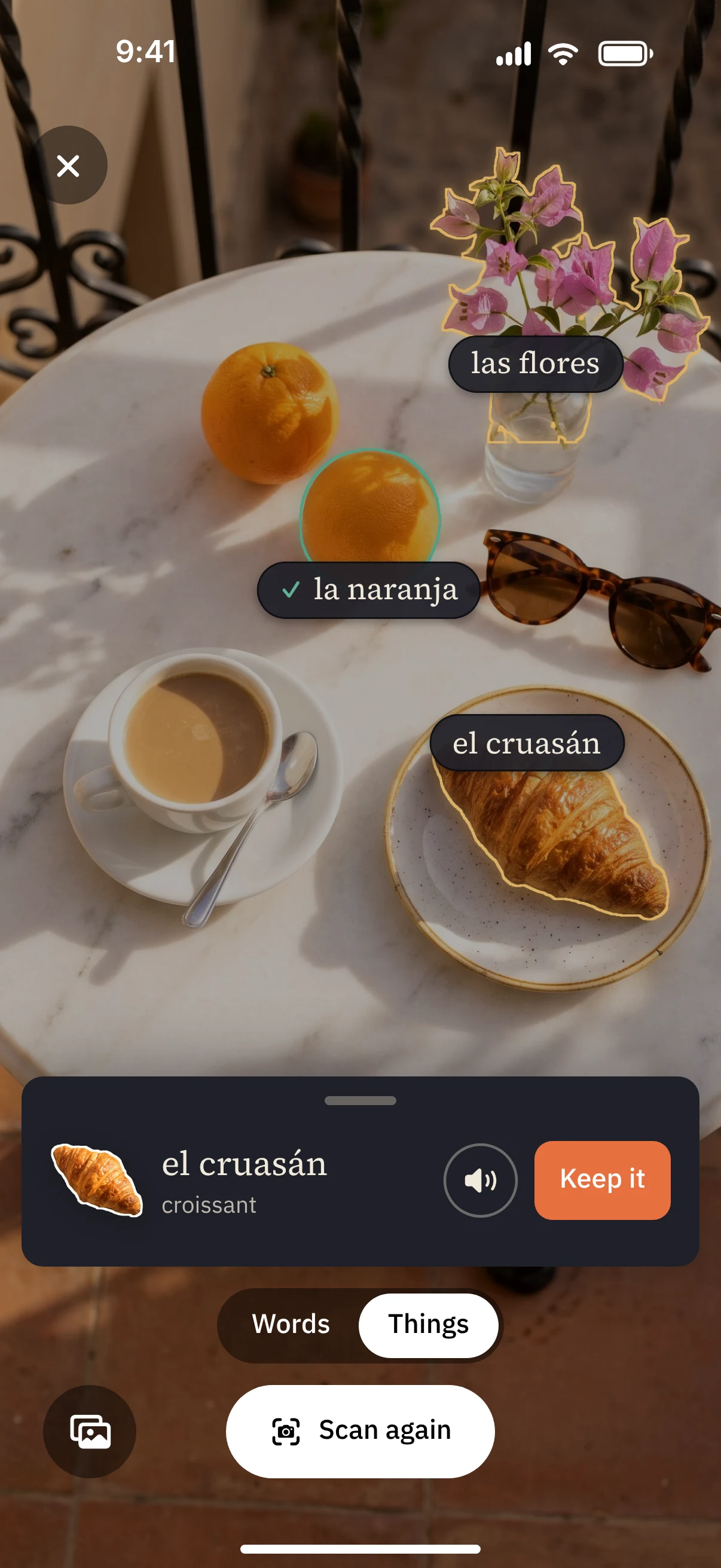
- The phone looks first. It finds the things it can name, tags each one with its word in your Spanish, and draws a thin outline around it. This happens on the phone, in about a second, and nothing leaves it.
- Tap a thing and it lifts off the photo as a sticker, cut out from your own picture, with its word, its meaning and a sentence to say it in. Tap anything the phone didn’t tag and it cuts that out instead.
- Keep it, and the word goes into your words with its sticker.
- Later, in practice, the card shows the sticker first and asks ¿Qué es? (what is it?). You say the word out loud, then turn the card over.
Your Spanish choice carries through: the same fridge comes out as la nevera (the fridge), el refri (the fridge) or la heladera (the fridge), depending on whose Spanish you’re learning.
Two buttons send something off the phone, and each says so before you tap it the first time. Find more sends that one photo to Google’s Gemini AI to spot more things in it, and the photo isn’t kept. It’s free three times a week, and part of Pensar Pro. Ask Paco names something the phone couldn’t, and it sends only the cut-out, never the rest of the photo. Ask Paco is free for everyone, up to 20 a day. A sticker you keep is saved to your account so it’s there on your other devices.
Questions people ask
How do you say “household items” in Spanish?
The most natural ways are los objetos de la casa (household objects) or simply las cosas de la casa (the things in the house). For appliances like the fridge or the washing machine, people say los electrodomésticos (household appliances).
Is it la nevera or el refrigerador?
Both are right; it depends on where you are. Spain and Colombia say la nevera, Mexico says el refri (short for el refrigerador), and Argentina says la heladera. El refrigerador is understood everywhere, so it’s a safe choice if you’re not sure.
Why is el sofá masculine?
Because the -a rule is a pattern, not a law. Sofá came into Spanish as a masculine word and stayed that way: el sofá, los sofás. A few common words do this, like el día and el mapa, which is why it pays to learn every noun with its el or la.
Does Pensar’s Things camera send my photos anywhere?
Not unless you ask it to. Finding things, naming them and cutting them out all happen on your phone. Find more sends that one photo to Google’s Gemini AI and the photo isn’t kept; Ask Paco sends only the cut-out. A sticker you keep is saved to your account so it syncs to your other devices.
Is the Things camera free?
Yes. Taking photos, the phone’s own tags, cutting out stickers, keeping them and practicing with them are all free. Find more is free three times a week, and Ask Paco up to 20 times a day. Pensar Pro lets Find more run on its own, on up to 20 photos a day.
How this postcard was made: Written by Shirish with Claude, in Paco’s voice. Every Spanish word comes from the word list inside the app and was checked against its code. The café photo in the camera screen was drawn by an image model, its sticker was cut out by the app’s own cut-out model, and Paco was drawn by his own animation code.