 Pensar
All postcards
Postcard No. 1 · How Pensar works
Hola, soy Paco. I’m a parrot, and I’m telling you to stop repeating
How to start thinking in Spanish, from a parrot who knows repeating doesn’t work: why you translate in your head, and what the research says gets you past it.
 By Paco, with Shirish Kadam
· 7 min read

In this postcard
Thinking in Spanish means a Spanish thought arrives without a stop in English first. You don’t get there by trying harder not to translate. You get there by making Spanish: answering questions, writing a few lines, saying things out loud, then finding out what worked. Translating in your head is a normal stage on the way, not a flaw.
Hola, soy Paco. I’m a parrot. Repeating things is my whole deal. So believe me when I tell you: repeating things is not how you learn Spanish.
I coach people in Pensar, an app whose name is the Spanish verb for “to think”. That’s the whole job. Here’s what I’ve learned about getting a human from “I translate everything” to “wait, I just said that without thinking”.
Why do I translate everything in my head?
Because at the start, your brain has no other road to the meaning. A new word like la cuenta (the bill) gets hooked to the English word you already know, and the English word is hooked to the idea. Spanish, then English, then meaning. Every time.
This isn’t a habit you picked up by doing something wrong. Psychologists Judith Kroll and Natasha Tokowicz describe it as the expected early stage: words in a new language “may rely on their counterparts in the first language” to reach their meaning (Kroll and Tokowicz, 2001). With practice, learners build a direct road from the Spanish word to the idea.
The part nobody tells you comes next. The same chapter says the direct road “does not necessarily occur automatically as a consequence of increasing exposure.” More listening alone may not get you there. Something else has to happen.
Does repeating phrases help you think in Spanish?
Less than it feels like. Repeating and re-reading feel productive because the words are right there. You recognize them, and recognizing feels like knowing.
Two old, well-tested findings say otherwise:
- Making beats reading. In five experiments, people remembered words they had to produce themselves better than words they simply read. “In all cases, performance in the generate condition was superior,” wrote Norman Slamecka and Peter Graf (1978).
- Recalling beats restudying. Henry Roediger and Jeffrey Karpicke had students either reread a passage or recall it. A week later, the recall group remembered 56% of it; the rereading group, 42% (2006).
That second study has a twist I love. Five minutes after studying, the rereading group was ahead, 81% to 75%. Repeating wins the quiz you take right away and loses the conversation you have next week.
What actually gets you thinking in Spanish?
Trying to say something you can’t quite say yet. That moment of “how do I say this?” is where the learning happens.
Linguist Merrill Swain spent years on this. When learners have to produce the language, they notice the gap between what they want to say and what they can say, and “noticing a problem can ‘push’ learners to modify their output” (Swain and Lapkin, 1995). Reading and listening rarely make you notice, because you can follow a sentence you could never have built.
Researchers even have a name for the goal. They call it second-language inner speech, and they describe reaching it as “attaining the capacity to think in a language other than the first” (de Guerrero, 2018).
Put those together and you get a loop:
- Meet some Spanish at your level: a story, a voice note, a menu.
- Answer it in your own words, written or out loud. No multiple choice.
- Find out what worked, then what to fix.
- Do it again tomorrow, pulling the words back out of memory instead of looking them up.
Each turn of the loop builds a bit more of the direct road. Eventually the English stop gets skipped, first for hola (hello), then for me pones un café (a coffee, please), then for whole thoughts.
How does Pensar make you answer instead of repeat?
It starts in the first minute. You don’t pick a course or watch a tutorial. I show you a word you already know, conversación (conversation), and you say it out loud. Then I ask: how would you say “information”?
Nobody has taught you that one. You work it out anyway: información (information). “You just worked out a word nobody taught you,” I tell you, and it’s true. That’s the making-beats-reading effect from earlier, on your second word.
Then comes your first hack card, the trick behind it: English words ending in -tion are already Spanish. Swap -tion for -ción, stress the end, and you have nación (nation), situación (situation) and celebración (celebration). English and Spanish both took these words from Latin, so you already own hundreds of them.
Then you order a coffee. Not from a list: you build the sentence. If it’s correct but not how people say it where your Spanish is from, I tell you so: “Perfect Spanish, and anyone would understand you.” Then I show you the local way, because the polite way to ask differs:
| Where your Spanish is from | How you ask | What it means, word for word |
|---|---|---|
| Spain | Me pones un café | You put a coffee down for me |
| Mexico and most of Latin America | Me da un café | You give me a coffee |
| Colombia | Me regala un café | You gift me a coffee (you still pay) |
Do that and you get your first passport stamp: “You ordered a coffee in Spanish.” Out loud, if you spoke it. Speaking counts double whenever you do it, though typing always works, because plenty of people feel silly talking to a phone.
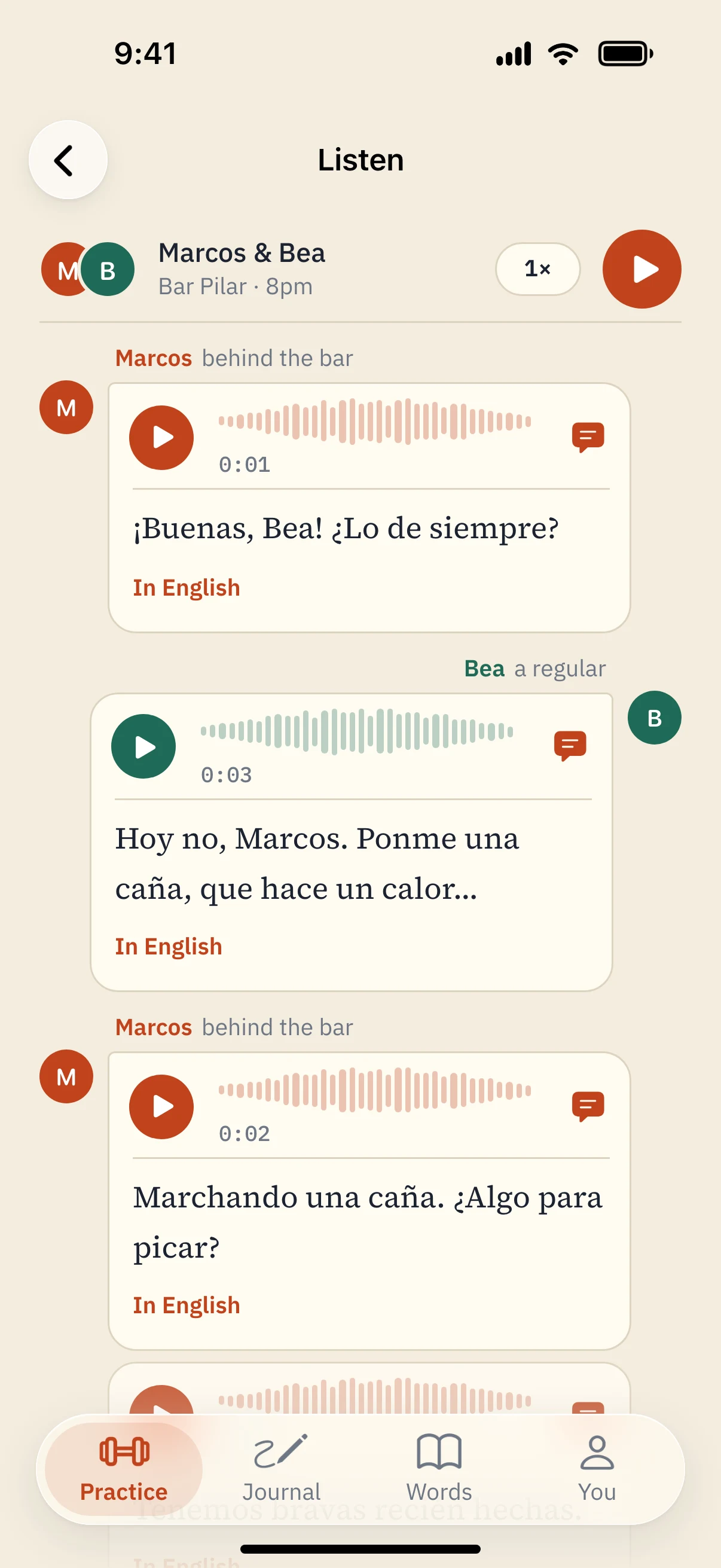
After that, every day is the loop. You listen to voice notes between locals, or read a short story written for your level, and then I ask you something about it. You answer in your own words.
You also get a journal page a day, about anything. When I check its Spanish, I start with what worked, quoting your own Spanish back to you, and only then mark the tricky bits. That order matters. You came to say things, so I show you that you said them.
What can I do today, with or without an app?
You don’t need Pensar to start thinking in Spanish. You need output, feedback and repetition spaced over days. Here’s a version that costs nothing:
- Ask yourself one question a day in Spanish, like ¿qué hiciste hoy? (what did you do today?), and answer it in two or three written sentences.
- Say the answer out loud once. It will be slower than writing. That’s the point.
- Check it with a teacher, a friend who speaks Spanish or a careful look in a dictionary. Look for what you got right first, then one thing to fix.
- Tomorrow, before writing the new one, try to say yesterday’s from memory. That’s the recall that won the study a week later.
- Keep a short list of the gaps you hit (“I didn’t know how to say I was tired”). Those are the next words worth learning.
The tips you’ll read elsewhere, like labeling your fridge or switching your phone to Spanish, are fine. They’re exposure. Just pair them with making.
Questions people ask
How long does it take to start thinking in Spanish?
There’s no honest single number. It depends on how much Spanish you produce, not how many hours you spend around it. Most learners notice it first in small, frequent phrases like greetings, ordering and saying how they feel, long before whole conversations. If you answer something in Spanish every day, you’ll usually catch yourself skipping English on those within weeks.
Is translating in your head bad?
No. It’s the normal first stage: new Spanish words lean on English words to reach their meaning, and researchers expect that. It only becomes a problem if you stay there, which happens when you only read and listen. Producing Spanish yourself, and getting feedback on it, is what builds the direct road from word to idea.
Why can I understand Spanish but not speak it?
Because understanding and producing are different skills. You can follow a sentence you could never have built, since the words are handed to you. Speaking asks you to find them yourself, which is the part most practice skips. The fix is regular output: answering questions, writing short pages, saying things out loud, then checking what worked.
Can a complete beginner think in Spanish?
Yes, in small pieces from the first day. A thought like tengo hambre (I’m hungry) or ¿me pones un café? (could I have a coffee?) can arrive in Spanish after a few times of saying it yourself. Pensar starts there: you say your first Spanish sentence, your own, in about four minutes.
How this postcard was made: Written by Shirish with Claude, in Paco’s voice. Every claim about the app was checked against its code, every study was opened and quoted from the source, and the pictures are the app’s real screens with Paco drawn by his own animation code.