 Pensar
All postcards
Postcard No. 2 · Whose Spanish
Spain or Mexico Spanish? A parrot’s guide to whose Spanish to learn
Spain vs Mexican Spanish, plus Argentina and Colombia: what really changes, what doesn’t, which words get you in trouble, and how to pick yours.
 By Paco, with Shirish Kadam
· 6 min read

In this postcard
Spain and Mexico share one Spanish. The grammar is the same and people understand each other fine. What changes for a learner is a short list: how you say “you” to a group, a few dozen everyday words, the sound of c and z, and how you ask for things. Learn the Spanish of the place you’ll use it first. The rest takes days to tune into, not months.
Hola, soy Paco. I’m a parrot, so technically my Spanish is from wherever I last heard it. You don’t have that luxury, and that’s fine. Here’s the honest version of the “which Spanish?” question.
How different are Spain and Mexico Spanish, really?
Less than the internet suggests. A few things change, and they change the same way every time, so you learn them once.
| What changes | Spain | Mexico |
|---|---|---|
| “You” to a group of friends | {vosotros | you all, informal} |
| Ordering a coffee | {me pones un café | put a coffee down for me} |
| Potato, peach, juice | patata, melocotón, zumo | papa, durazno, jugo |
| A plaster for a cut | tirita | curita |
| The bus | el autobús | el camión |
| “Cool!” | {¡guay! | cool} |
| The letters c and z (before e or i) | Mostly a “th” sound | An “s” sound |
The words in that table come from Pensar’s own word notes, the ones I show learners next to each word.
The “you” one is the only grammar on the list, and it’s smaller than it looks. Linguist Miguel Calderón Campos describes the Americas and the Canary Islands as the places where “ha desaparecido el pronombre vosotros” (Calderón Campos, 2010). Everywhere, ustedes (you all) works for a group. Spain just has one more, friendlier option.
Is it just Spain and Mexico?
No, and this is the part most guides skip. “Latin American Spanish” isn’t one thing. Buenos Aires and Mexico City sound nothing alike, and Bogotá has habits of its own.
It’s also worth knowing who’s talking. The Instituto Cervantes counts 520 million native Spanish speakers in 2025: “supera en 2025 por primera vez los 500 millones de hablantes” (Instituto Cervantes, 2025). Of those, about 130 million are in Mexico, 52 million in Colombia and 47 million in Spain, by the report’s own table.
So Spain is the Spanish with the most textbooks, and Mexico is the Spanish with the most people. Two more deserve a seat at the table.
What is voseo, and do I need it?
In Argentina and Uruguay, people say vos (you) instead of tú (you), with verb forms of its own. Calderón Campos gives the textbook example: “este modelo VV se identifica con el voseo argentino: vos tenés” (same source). Vos tenés (you have) instead of tú tienes (you have).
The sound changes too. In Buenos Aires, calle (street) sounds like “ca-she”. If that’s where you’re going, learn it from day one; it’s not hard, just different. If you’re not going there, you only need to recognize it.
Why do Colombians say usted to their friends?
Because in Colombia, usted (you, formal) isn’t only for strangers. Linguists call it ustedeo (using usted among friends): “el empleo de usted en situaciones de confianza o intimidad, es decir, entre amigos, novios o cónyuges” (Calderón Campos, 2010). He adds that Colombia is the second country where it’s common, after Costa Rica.
For a learner that’s good news. Usted is never rude, so in Colombia you can lean on it. Colombia also has the loveliest way to order: me regala un café (gift me a coffee). You still pay.
Which words get you in trouble?
Mostly one. In Spain coger (to take, to grab) is everyday: you coges el autobús (take the bus). In much of the Americas it’s vulgar. The Diccionario de americanismos marks it “vulg” for Mexico, Central America, Venezuela, Argentina and Uruguay, among others (ASALE). There, you tomas el camión (take the bus).
That’s the famous one. The rest of the list is gentler: a tortilla (omelette in Spain, flatbread in Mexico) is a different dinner on each side of the ocean, and a manzana (apple, or a city block in Spain) can be a fruit or a street corner.
So which Spanish should I learn?
| If you’re... | Learn | Why |
|---|---|---|
| Moving to or visiting one country | That country’s | You’ll hear it every day; the rest you can recognize later |
| Learning for family or a partner | Theirs | It’s the Spanish you’ll actually speak at dinner |
| Living in the US | Mexico’s | It’s likely the Spanish you’ll hear most |
| Going to several countries | One of them, plus ustedes | Ustedes works everywhere; recognizing vos and vosotros is enough |
| Not sure yet | Mexico’s or general Latin American | The most speakers, and understood everywhere |
Whatever you pick, don’t switch every week. The differences are small, but juggling three versions of “you” at once is not.
How does Pensar handle whose Spanish?
When you start, I ask where you’ll use your Spanish: Spain, Mexico, Argentina and Uruguay, Colombia, the rest of Latin America, or “not sure yet”.
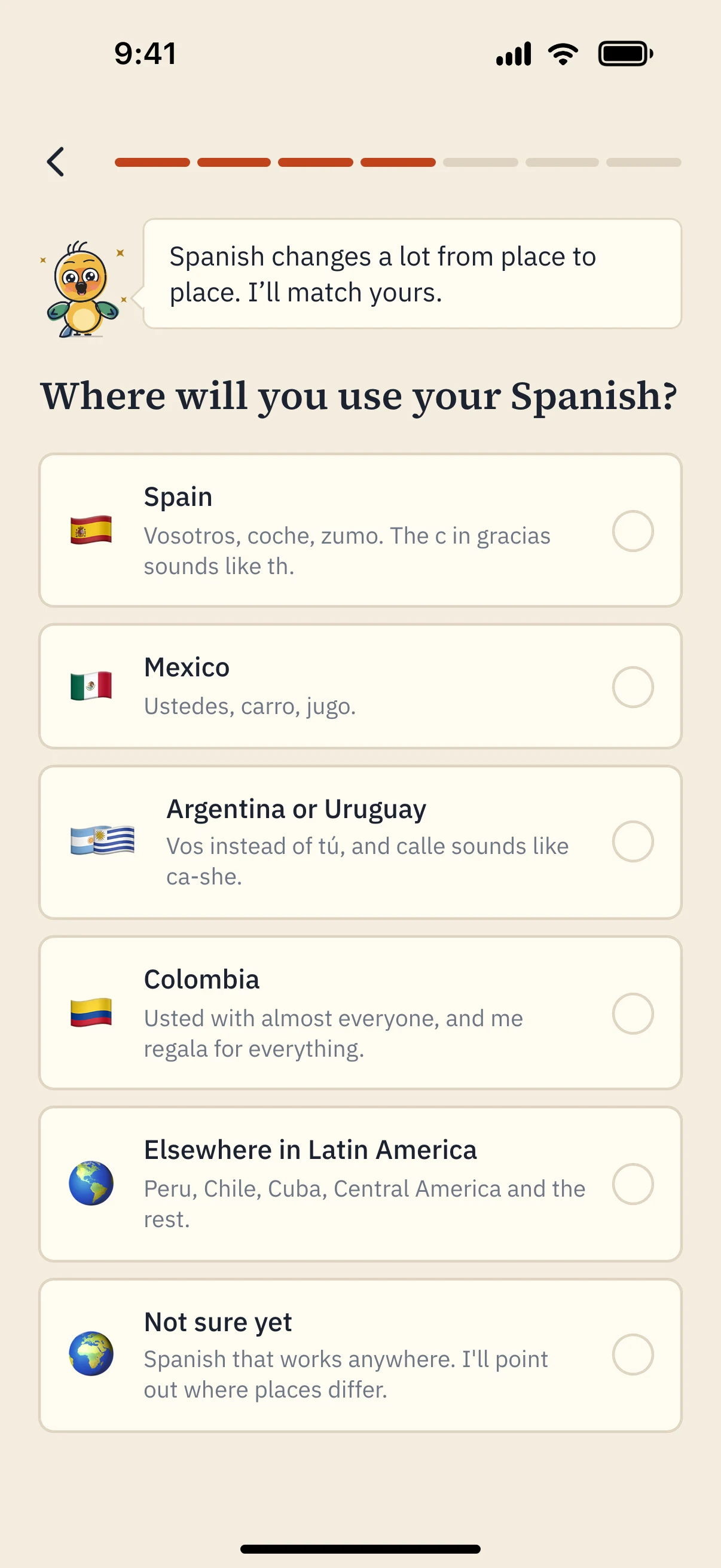
That choice changes a lot quietly:
- The voices and the microphone follow it: Buenos Aires voices, and a microphone listening for a Buenos Aires accent.
- The everyday words follow it. Point the camera at an orange juice in Spain and you get el zumo (juice); in Mexico, el jugo (juice).
- The verbs show the people you’ll actually say them to: vosotros only for Spain, vos for Argentina and Uruguay.
- The notes point out the neighbors: “In Mexico it’s el jitomate”, “Tirita in Spain. In Latin America it’s a curita.”
- The city your scenes come from: Madrid, Sevilla or Barcelona; Mexico City or Oaxaca; Buenos Aires or Montevideo; Bogotá, Medellín or Cartagena; Cusco or Havana, among others.
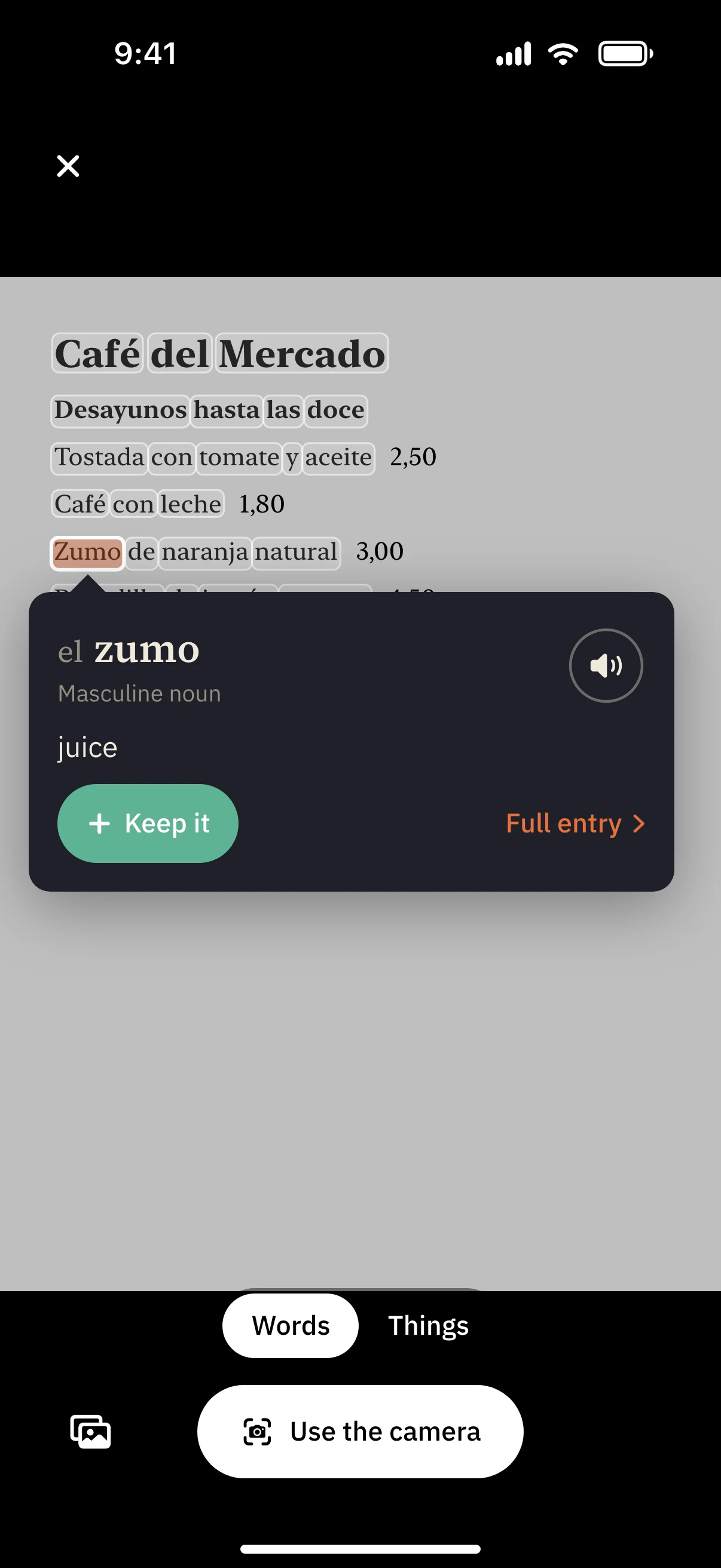
You can change it any time in Settings. Levels work the same way: you start where you are, from your first words to fluent, and the stories and voice notes follow you up.
Questions people ask
Can Mexicans and Spaniards understand each other?
Yes. They share one grammar and almost all their everyday words, so a conversation works from the first sentence. What takes a little getting used to is the accent and a handful of words, like zumo and jugo for juice, or coger, which is everyday in Spain and rude in Mexico.
Do I need to learn vosotros?
Only if you’re learning the Spanish of Spain. Everywhere else, and in Spain too, ustedes works for any group, formal or not. If you learn Latin American Spanish, it’s enough to recognize vosotros when you hear it, the same way you’d recognize “y’all” without needing to say it.
What is voseo?
Voseo is using vos instead of tú for “you”, with its own verb forms: vos tenés instead of tú tienes. It’s the everyday way to talk in Argentina and Uruguay. Learn it if that’s where you’re going; otherwise recognizing it is enough.
Why is coger a bad word in Latin America?
Because in much of the Americas it’s slang for sex. In Spain it simply means to take or grab, as in coger el autobús. In Mexico, Argentina and many other countries, say tomar instead: tomar el camión, tomar el colectivo. Spaniards will understand you either way.
Which Spanish is easiest for beginners?
None is easier; they’re the same language with different habits. Pick the one you’ll use, because hearing it around you is what makes it stick. If you have no plans yet, Mexico’s Spanish has the most speakers and the most to listen to.
How this postcard was made: Written by Shirish with Claude, in Paco’s voice. The word differences come from Pensar’s own content files, every source was opened and quoted, the map was drawn by an image model without Paco in it, and Paco was drawn by his own animation code.