 Pensar
All postcards
Postcard No. 5 · Journal
A diary that talks back, and asks first: journaling in Spanish
How to keep a journal in Spanish as a beginner: what to write, how long, whether to fix every mistake, and ten prompts you won’t find on other lists.
 By Paco, with Shirish Kadam
· 6 min read

In this postcard
Journaling in Spanish means writing a few sentences a day about your own life, in Spanish, and then getting them checked. Start tiny: three sentences answering one question. Don’t fix every mistake. Research suggests a few well-chosen corrections, and praise that names what you did well, help more than red ink everywhere.
Hola, soy Paco. In Pensar I keep a diary with you, sort of. You write the page. I check your Spanish. And I always start with the good part, because that’s not just nice, it’s what works.
What should a beginner write in a Spanish journal?
Your actual day, in the words you actually have. The trick is a question small enough to answer with what you know. “Write about your weekend” is a cliff. ¿Qué comiste hoy? (what did you eat today?) is a step.
For your very first page, three sentences are plenty:
- One fact. Hoy fui al mercado. (Today I went to the market.)
- One feeling. Estoy cansado, pero contento. (I’m tired, but happy.)
- One detail. Compré naranjas. (I bought oranges.)
You’ll hit words you don’t have. Good. Write them in English in brackets, look them up after, and those are your next words. The gap you notice is the lesson.
How long should a Spanish journal entry be?
Short enough that you’ll do it again tomorrow. No study I could find sets an ideal length, so here’s a judgment call. In Pensar, a full page grows with your level: 25 words for a first-timer, 40 for a beginner, up to 120 when you’re fluent. A page that hits its length earns the most points; going past it doesn’t earn more, and a very long page gets a gentle “Save some for tomorrow.”
Should I correct every mistake?
No, and this is where most advice goes quiet. The research has argued about it for thirty years:
- One side said stop. John Truscott’s famous paper argued that “grammar correction in L2 writing classes should be abandoned” (Truscott, 1996).
- The evidence says it helps, with conditions. A meta-analysis of 21 studies found that written correction “can lead to greater grammatical accuracy,” yet “its efficacy is mediated by a host of variables” (Kang and Han, 2015).
- Less is more. Icy Lee, a writing researcher, put it plainly: “more written corrective feedback is not better, but instead less is more” (Lee, 2019).
So: a few fixes, chosen well. And in classic dialogue journals, where a teacher writes back, “overt error correction is not done in the journals” at all; the teacher’s reply models the right Spanish instead (Peyton, Center for Applied Linguistics).
Does praise actually help?
Only if it says something. In their big review of feedback, John Hattie and Helen Timperley found that praise on its own “is unlikely to be effective, because it carries little information” (Hattie and Timperley, 2007).
“¡Muy bien!” tells you nothing. “You told a clear story in the past” tells you what to do again. So my praise always quotes your own Spanish back to you: here’s the sentence, here’s what it did right.
How does Pensar’s journal work?
You get one question a day, from forty that rotate through eight kinds: small joys, the day, people, the city, looking ahead and more. You answer by writing or by talking. Nothing gets marked while you write.
When you save, I check your Spanish. Here’s a real page:
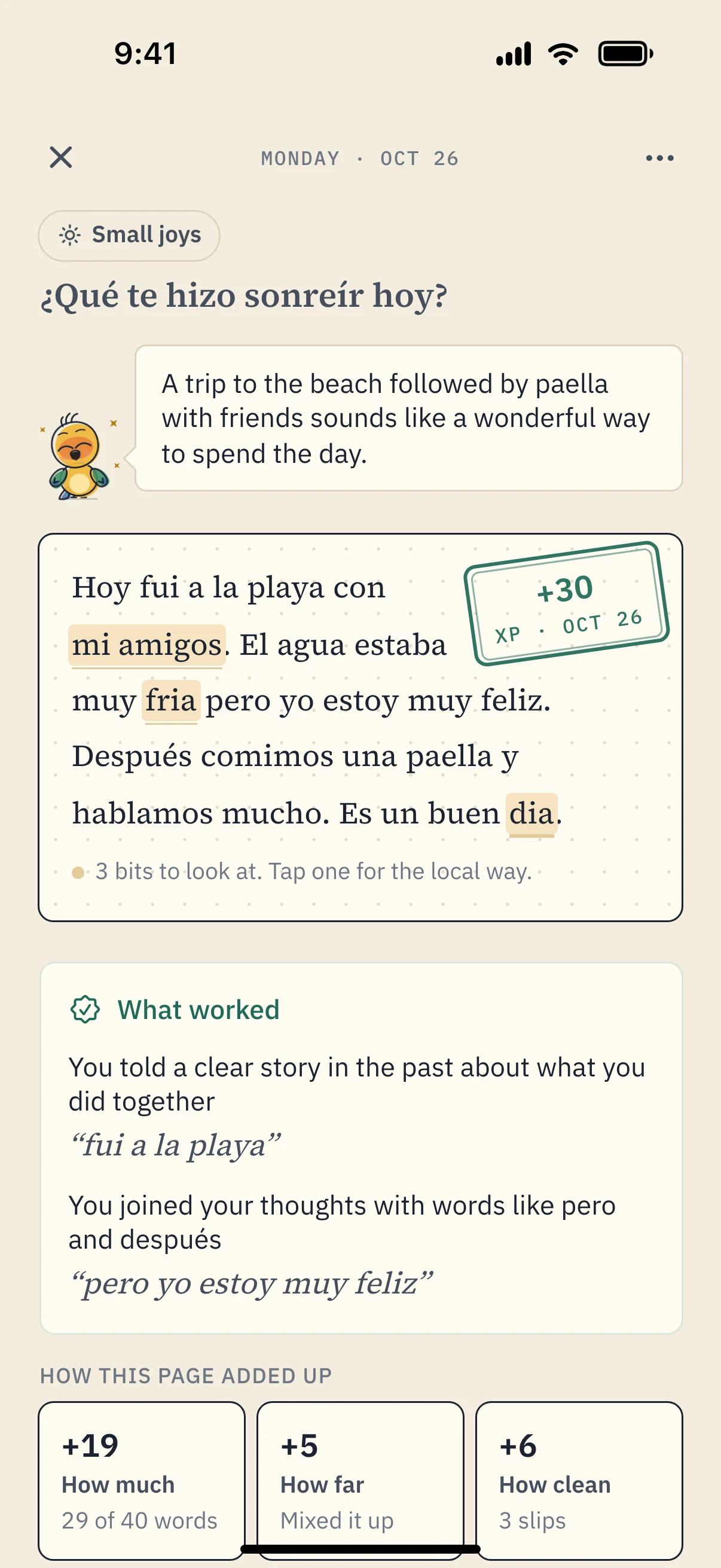
- What worked, first. “You told a clear story in the past about what you did together”, with fui a la playa (I went to the beach) quoted back.
- Then a few tricky bits, highlighted in place: mi amigos (my friends) wants mis, fria (cold) wants its accent, fría (cold). Tap one for the local way, and take the fix if you like it.
- How it added up: how much you wrote against your level’s page, how far you reached, and how clean it was. Saying it out loud counts double.
There’s a calendar of your pages, so you can flip back a month and see the difference. And if a page says you’re having a hard time, I answer that first, with care, and a link to someone who can help.
Who reads my journal?
You, and nobody else in Pensar. Your pages are private to your account, and your voice notes are saved only on your phone.
Before I check your Spanish the first time, I ask. The sheet says it in plain words: to check your answers, Pensar sends what you write and say to Google’s Gemini AI, and “your journal goes to Google only.” The AI companies don’t train on it. Tap “Not now” and none of your words go anywhere; journal tips just wait until you say yes. You can change your mind any time in Settings.
Ten journal prompts you won’t find on other lists
| Prompt | In English | Good for |
|---|---|---|
| ¿Qué hay en tu bolso ahora mismo? | What’s in your bag right now? | First words: hay + things |
| ¿Qué sonidos oyes ahora mismo? | What sounds can you hear right now? | Beginners: oír |
| Describe a una persona que viste hoy. | Describe someone you saw today. | Ser, estar and describing words |
| ¿Qué comiste hoy y con quién? | What did you eat today, and with whom? | The past tense |
| ¿Qué te molestó hoy, aunque sea un poco? | What bothered you today, even a little? | Molestar works like gustar |
| Cuenta un pequeño problema de hoy y cómo lo resolviste. | A small problem today and how you solved it. | Telling a story in order |
| Explica cómo se prepara algo que sabes hacer bien. | Explain how to make something you’re good at. | Instructions with se |
| ¿Qué hacías a esta hora hace un año? | What were you doing at this time a year ago? | The other past tense |
| Escríbele a alguien con quien hace tiempo que no hablas. | Write to someone you haven’t talked to in a while. | Writing to a person |
| Si tu día fuera una película, ¿de qué género sería? | If your day were a film, what genre would it be? | Daydreaming in Spanish |
Questions people ask
How do you say journal in Spanish?
A personal journal or diary is un diario: escribo en mi diario todos los días. Una bitácora is a logbook, and una revista is a magazine, not a journal. For “to journal”, Spanish just says escribir un diario.
Is journaling in Spanish good for learning?
Yes, because it makes you produce Spanish about your own life, which is the Spanish you’ll actually need. Writing gives you time to find the words that speaking doesn’t. It works best when someone checks it: a teacher, a friend, or an app, starting with what you got right and fixing a few things, not everything.
Should I correct every mistake in my Spanish journal?
No. Research on written feedback finds that correction helps, but more isn’t better. Pick a few mistakes that matter, often the ones you repeat, and leave the rest. A page covered in corrections teaches less and makes you less likely to write tomorrow.
How long should a Spanish journal entry be?
Short enough to do every day. Three sentences is a real first page. In Pensar the target grows with your level, from 25 words for a first-timer up to 120 when you’re fluent. Consistency matters more than length: a short page daily beats a long one weekly.
Can a complete beginner keep a journal in Spanish?
Yes. Start with one question you can answer in three sentences, like what you ate today. Write the words you don’t know in English in brackets and look them up afterwards. Those gaps are exactly the words worth learning next.
How this postcard was made: Written by Shirish with Claude, in Paco’s voice. How the journal works was checked against the app’s code, every study was opened at its source, and the pictures are the app’s real screens with Paco drawn by his own animation code.