 Pensar
Spanish words
Blog
Spanish level test
Twelve questions, about three minutes. They get harder when you’re right and easier when you’re not, and at the end you get your level, from A1 to C1, with what to work on next.
FreeNo emailResult on this page
Say “not sure” rather than guess. A lucky guess sends you a level too high.

The test
Without JavaScript the test can’t adapt, so here is every question, easiest first. Pick an answer to see if you had it.
-
¡Eso es!
It’s es.
A job is what someone is, so it takes ser: es camarera.
-
¡Eso es!
It’s está.
How something is right now takes estar: está cerrado.
-
¡Eso es!
It’s Hay.
Hay is “there is”: whether something exists at all.
-
¡Eso es!
It’s tiene.
Age takes tener, and tu hermana is ella: tiene.
-
¡Eso es!
It’s el.
Problema ends in -a but it's masculine: el problema.
-
¡Eso es!
It’s mucho.
Calor is a noun, so it takes mucho, not muy.
-
¡Eso es!
It’s Cómo.
¿Cómo te llamas? is literally “how do you call yourself?”
-
¡Eso es!
It’s Son las tres y media..
La hora is feminine, so media; and from two o'clock on it's son las.
-
¡Eso es!
It’s gustan.
Gustar agrees with what's liked: las naranjas, so gustan.
-
¡Eso es!
It’s se.
Ducharse is reflexive, and for ella it's se: se ducha.
-
¡Eso es!
It’s Conoces.
People you know take conocer; facts and skills take saber.
-
¡Eso es!
It’s Tengo.
Spanish has hunger rather than being hungry: tengo hambre.
-
¡Eso es!
It’s puedo.
Poder changes o to ue in the present: puedo.
-
¡Eso es!
It’s Lo.
El café is masculine, so it's lo: lo quiero.
-
¡Eso es!
It’s mejor.
Bueno has its own comparative: mejor, never más mejor.
-
¡Eso es!
It’s hace dos días.
Ago is hace plus the time, and hace comes first: hace dos días.
-
¡Eso es!
It’s jugaba.
A habit in the past takes the imperfect: jugaba.
-
¡Eso es!
It’s vi.
One finished moment, ayer, takes the preterite: vi.
-
¡Eso es!
It’s vengas.
Wanting someone else to do something takes the subjunctive: quiero que vengas.
-
¡Eso es!
It’s para.
A deadline takes para: para el lunes.
-
¡Eso es!
It’s por.
What you're thanking someone for takes por.
-
¡Eso es!
It’s Venga.
An instruction to usted uses the subjunctive form: venga.
-
¡Eso es!
It’s Me da vergüenza..
Embarazada means pregnant. Embarrassed is me da vergüenza.
-
¡Eso es!
It’s Me gusta nadar..
Where English uses -ing as a noun, Spanish uses the infinitive: nadar.
-
¡Eso es!
It’s tuviera.
An unlikely if takes the imperfect subjunctive: si tuviera, iría.
-
¡Eso es!
It’s fuera.
“If I were you” is si yo fuera tú.
-
¡Eso es!
It’s venga.
Doubt takes the subjunctive: no creo que venga.
-
¡Eso es!
It’s tienes.
Creo que states what you believe, so the indicative: tienes. No creo que would take the subjunctive.
-
¡Eso es!
It’s estaba.
Reporting what was said moves the present back: está becomes estaba.
-
¡Eso es!
It’s Aunque.
Aunque with the subjunctive is “even if”: aunque llueva.
-
¡Eso es!
It’s sin embargo.
Sin embargo is “however”, between two full sentences.
-
¡Eso es!
It’s ¿Me ayudas?.
Asistir and socorrer exist, but nobody asks a friend that way: ¿me ayudas?
-
¡Eso es!
It’s hubieras.
Ojalá about the past takes the pluperfect subjunctive: ojalá hubieras venido.
-
¡Eso es!
It’s quiera.
No es que denies a reason, so it takes the subjunctive: no es que no quiera.
-
¡Eso es!
It’s expliques.
Por mucho que, “however much”, takes the subjunctive: por mucho que se lo expliques.
-
¡Eso es!
It’s salgamos.
Como with the subjunctive is a warning, “if we don't”: como no salgamos ya.
-
¡Eso es!
It’s dijeras.
After a wish about the past, the subjunctive moves back too: hubiera preferido que me lo dijeras.
-
¡Eso es!
It’s I'm fed up..
Hasta las narices, “up to the nostrils”, is fed up to the eyeballs.
-
¡Eso es!
It’s Quedo a la espera de.
Quedo a la espera de su respuesta is the set phrase that closes a formal email.

Your level
A1 First words
Two or three thoughts a sentence, everyday situations.
Work on next Short sentences with ser, estar and tener, and the questions you'll need in a shop or a bar: ¿cuánto cuesta?, ¿dónde está?
When Pensar asks where you are, pick First words. Your first lesson starts right there.
Your level
A2 The basics
Shops, bars, short exchanges.
Work on next Talking about your day and what you like: gustar, reflexive verbs like me levanto, and the past with fui and hice.
When Pensar asks where you are, pick The basics. Your first lesson starts right there.
Your level
B1 Getting by
Longer sentences, opinions, the past.
Work on next Telling a story in the past, mixing jugué and jugaba, and starting on quiero que plus the subjunctive.
When Pensar asks where you are, pick Getting by. Your first lesson starts right there.
Your level
B2 Comfortable
Nuance, register, arguing a point.
Work on next What would happen if (si tuviera…), what someone said (me dijo que…), and linkers like aunque and sin embargo, until they come without thinking.
When Pensar asks where you are, pick Comfortable. Your first lesson starts right there.
Your level
C1 Fluent
Idiom, irony, speed.
Work on next Idiom, register and speed: the subjunctive in every corner, and the Spanish of one place, its slang included.
When Pensar asks where you are, pick Fluent. Your first lesson starts right there.
How you did at each level
Pensar is coming soon to iPhone and iPad.
A quick estimate on the CEFR scale, the one the DELE uses, not a certificate.
What the levels mean
Every Spanish course and exam uses the same six levels, the CEFR. Here is what each one feels like, and what Pensar calls it.
- A1First wordsTwo or three thoughts a sentence, everyday situations.
- A2The basicsShops, bars, short exchanges.
- B1Getting byLonger sentences, opinions, the past.
- B2ComfortableNuance, register, arguing a point.
- C1FluentIdiom, irony, speed.
- C2Like a localRegional slang and everything else.
How the test works
It adapts
You start at A2. A right answer takes you a level up, a wrong one a level down, so after twelve questions you’ve spent most of them around your real level.
Where the questions come from
From A1 to B2 they’re Pensar’s own practice questions, the ones the app asks after each grammar note. C1 is written for this test.
How it decides
Your level is the highest one where you answered at least two questions and got most of them right. C2 needs more than twelve questions, so the test stops at C1.
Pensar
Stop memorizing. Start thinking in Spanish.
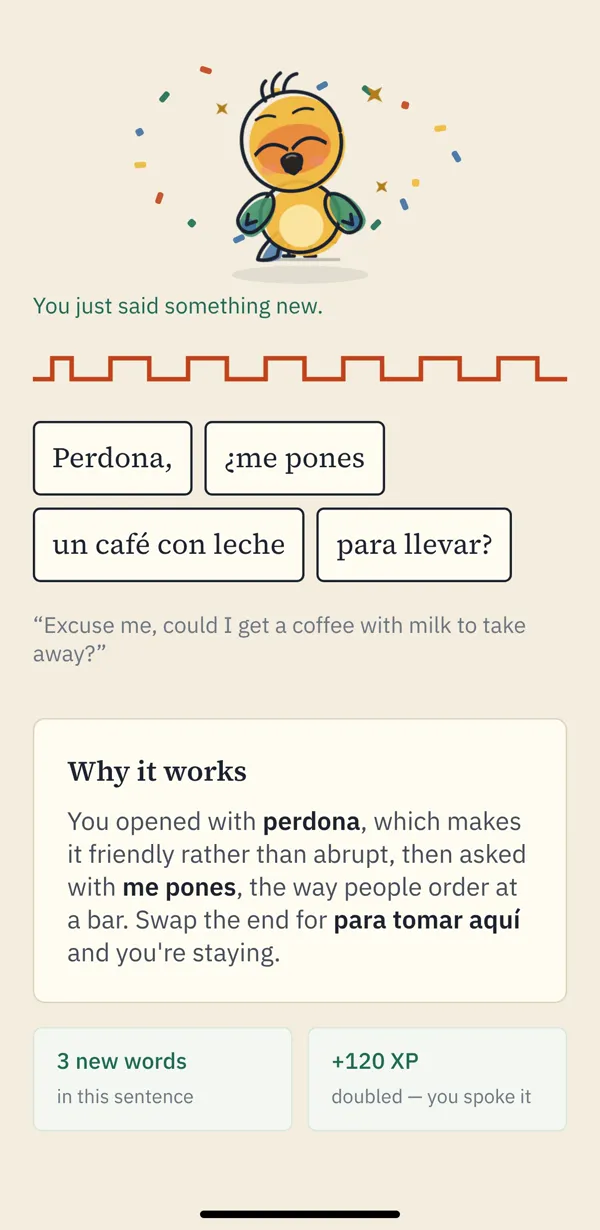
Pensar has you build real sentences from your first day, answer locals’ voice notes and write a page a day, and Paco marks what you got right first.

Coming soon to iPhone and iPad
First lesson free. No ads. No account needed to start. See what Pensar does.
Questions people ask
How accurate is this Spanish level test?
It's a quick estimate. Twelve questions that adapt to your answers find the level you're working at, but only an exam like the DELE or the SIELE gives you a certificate. Use the result to choose where to start.
Is this the DELE?
No. The DELE is the Instituto Cervantes' official exam. This test uses the same scale, the CEFR, from A1 to C2, so your result tells you roughly which DELE level to aim for.
What do A1, A2, B1, B2 and C1 mean?
They're the levels of the CEFR, the European scale every Spanish course and exam uses. A1 is your first words, B1 is getting by on your own, and C1 is fluent, with idiom and speed.